
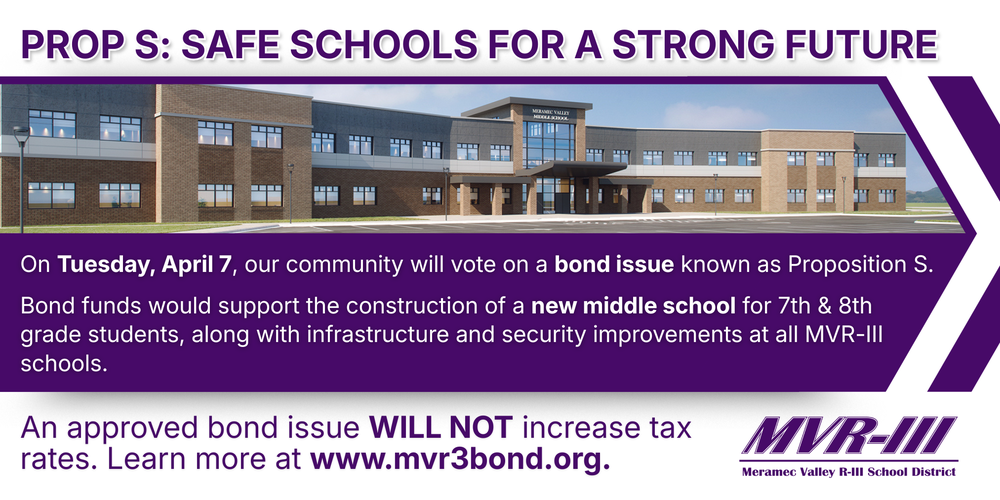
Voter-approved funds would support a new middle school and facility improvements at every school, without raising property tax rates
On April 7, Meramec Valley R-III School District residents will vote on a $43 million general obligation bond proposal that would allow the district to construct a new middle school and make additional improvements throughout its campuses—all without raising property tax rates.
The bond issue, known as Proposition S, will require 4/7th majority support (57.14%) from voters to pass.
“Prop S will provide access to the financial resources we need to create new learning environments, enhance safety and security, and provide much needed facility improvements at every school,” said Superintendent Dr. Carrie Schwierjohn. “This bond is all about our students and staff- these facility improvements will allow our district to better serve the needs of our students and staff, and position MVR-III for success in the future.”
Approximately $38 million of the bond’s proceeds will support the construction of a new middle school for 7th- and 8th-grade students to replace Pacific Intermediate. Students in 5th and 6th grade would shift to Riverbend Middle School under the proposal.
Finding a long-term solution to address the issues at Pacific Intermediate has been a goal of MVR-III officials for years. The school is 73 years old, and comprehensive assessments of the building have found that the mechanical, electrical, and plumbing systems are beyond their useful life expectancy, the infrastructure is deteriorating, and the classrooms and common areas are unable to accommodate 21st century learning.
Every student currently in prekindergarten through 5th grade will experience attending the new middle school when it’s complete.
The District opted for plans to build a new school after architects and building specialists determined that the cost of new construction would be comparable to that of a full-scale renovation at Pacific Intermediate. The new school will be built near Pacific High School.
However, the district will still use parts of the Pacific Intermediate campus. The smaller wing built in 1999 will be renovated for special education and alternative programs, while the older wings will provide much needed district storage space.
“This investment allows us to better align our facilities with the evolving needs of our students and families,” Schwierjohn said. “A new middle school will provide modern, flexible learning spaces designed to support student success at a critical stage in their education. At the same time, the changes at Pacific Intermediate mean we can create dedicated, supportive environments for our special education and alternative programs. Together, these improvements will help us serve every student more effectively while strengthening our ability to meet the needs of our community.”
With student safety and security a top priority for MVR-III, Dr. Schwierjohn noted that critical investments will be made with bond funds across all district campuses, including the installation of keyless entry systems and new security cameras.
At Pacific High School, the demand among students for culinary education has steadily grown. Course requests for the 2025-26 school year exceeded availability, with 144 seats in Culinary I available compared to 245 requests. Meanwhile, Culinary II offered 72 seats compared to a total request of 124. To meet the demand, the district will use bond funds to expand and renovate the high school’s Culinary Arts Lab. Grant money will also allow the district to purchase new equipment for the renovated space. These changes will allow the Culinary Arts program to provide students with more training and access to potential career fields.
The MVR-III School District’s debt levy tax rate will not change with an approved bond issue on April 7. More information about Proposition S and answers to frequently asked questions are available at www.mvr3bond.org.
“We are incredibly grateful to our community members for the time, thoughtful questions, and meaningful feedback they have shared as we prepare for the upcoming bond vote,” Dr. Schwierjohn said. “This level of engagement reflects how deeply our community cares about our students, staff, and schools. We encourage everyone to continue learning about the proposal and to carefully consider its impact, as this is an important step in supporting our students today and strengthening the future of our district.”